
Comparison
Does MyFitnessPal Track Micronutrients? What It Shows, What It Misses
MyFitnessPal is the default food tracker for millions of people. But if you're trying to track vitamins and minerals — not just calories — how far does it actually take you?
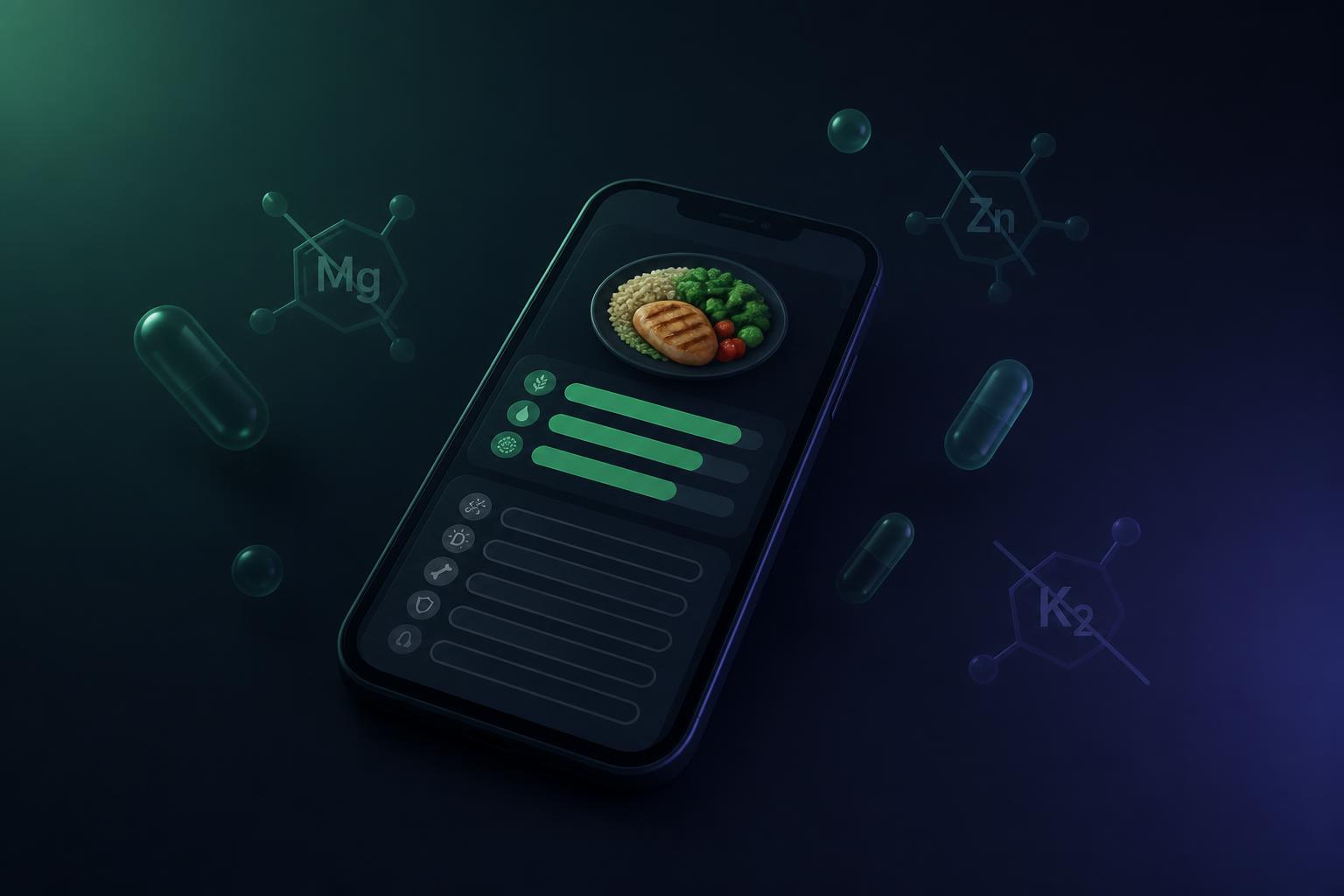
The short answer
Yes — MyFitnessPal tracks roughly a dozen micronutrients on Premium. But coverage is shallow, data quality depends on crowdsourced entries, and it only shows a single-day view. For anyone actually trying to spot nutrient gaps, that's not enough.
MyFitnessPal has over 200 million accounts. It's the most-searched food tracker on the planet. So when somebody types "does MyFitnessPal track micronutrients" into Google, they're rarely curious — they're usually frustrated. They opened the app, looked for magnesium, and couldn't find it.
This post answers the question precisely: what MyFitnessPal does track, what it doesn't, and why a complete micronutrient picture needs more than the daily nutrition tab can offer.
What MyFitnessPal actually tracks
Out of the box, the free tier of MyFitnessPal shows you seven things: calories, protein, carbs, fat, sugar, fibre and sodium. That covers macros and a couple of headline nutrients. It does not cover vitamins or minerals.
On Premium, the nutrition tab expands. You can pin additional fields to your daily view — typically:
- Vitamin A, vitamin C, vitamin D
- Calcium, iron, potassium
- Saturated fat, polyunsaturated fat, monounsaturated fat, trans fat
- Cholesterol
That's roughly a dozen micronutrients, depending on how you count fats. It's better than nothing. It's also less than a fifth of what your body actually depends on.
The four real problems
The headline numbers are the easy part. The harder issues only show up once you've used the app for a few weeks.
1. The food database is crowdsourced
MyFitnessPal's database — more than 14 million entries — is mostly user-submitted. Anyone can add a food. Most micronutrient fields in those entries are left blank, because the person who created the entry only cared about calories. Search "chicken breast" and you'll get hundreds of versions, almost all of them with zero values for vitamin A, vitamin C, calcium and iron — not because chicken breast has none, but because nobody filled in those fields.
Cronometer takes the opposite approach, building on verified USDA and NCCDB data. That's why people serious about micronutrients usually migrate to it eventually.
2. Most micronutrients aren't tracked at all
Even on Premium, the following nutrients — all common deficiency targets in modern diets — are not in MyFitnessPal's daily view:
- Magnesium. Roughly half of US adults fall below the EAR. Linked to sleep, muscle function and insulin sensitivity.
- Zinc, selenium, iodine. Immune function, thyroid, DNA repair.
- Vitamin K (both K1 and K2). Bone and arterial health.
- B vitamins beyond B12. Folate, B6, riboflavin, niacin, thiamine — all involved in energy metabolism.
- Omega-3 (EPA/DHA). Tracked indirectly as polyunsaturated fat, not separated from omega-6.
- Choline. Critical for liver and brain function; ~90% of adults are below adequate intake.
3. Daily view, not a horizon
Your body doesn't deplete magnesium on Tuesdays and replenish it on Wednesdays. It buffers over weeks.
MyFitnessPal's nutrition tab resets every midnight. If you hit 80% of your iron target on Monday and 130% on Tuesday, the app shows you a red bar and a green bar — not the obvious truth that your two-day average is fine.
Most fat-soluble vitamins (A, D, E, K) and most minerals operate on a weekly-to-monthly equilibrium, not a daily one. A 14-day rolling average is the smallest window that matches the underlying biology — which is the basis of the model we explain on the science page.
4. No recommendations to close gaps
Even if MyFitnessPal showed you a clean micronutrient profile, it would stop there. It tells you what you ate. It doesn't tell you what to eat next to seal the gap that just opened in your zinc or your B12. Every dietitian we've spoken to says the same thing: the diagnosis is the easy part. The hard part is what to put on the plate tomorrow.
What a complete micronutrient tracker should do
If you're shopping for a replacement, run any candidate against this checklist:
- Tracks 25+ micronutrients, not just the headline six
- Uses a verified food database (USDA, NCCDB or equivalent) — not user submissions
- Aggregates intake over a rolling 14-day window, not a single calendar day
- Shows status, not just totals — color-coded by deficiency / adequate / excess
- Recommends specific foods to close the gaps it identifies
- Has an entry method you'll actually stick with for 90+ days
That last bullet is the one that quietly defeats every tracker. A perfect database is worthless if you stop logging by week three. This is why photo-based entry — one snap per meal instead of barcode + portion + brand + serving — matters more than any database feature.
The alternatives, ranked
Cronometer
The serious alternative. Verified database, 80+ nutrients, and a loyal biohacker following. Same daily-view limitation as MyFitnessPal, and the same manual-logging burden — but the data underneath is the best in the category.
Lifesum, Lose It, Noom
All three are weight-loss-first apps that bolt on macro tracking. Micronutrient coverage is at or below MyFitnessPal's free tier. Useful for calorie targets, not for nutrient intelligence.
VitaMenda
We built VitaMenda because the trackers above force a trade between accuracy and adherence. Snap a photo of any meal — VitaMenda identifies ingredients, computes 25+ nutrients against a verified database, and aggregates everything on a rolling 14-day horizon. Then it recommends specific foods to close the gaps it finds. No barcodes, no portion sliders, no daily streaks. See how the app works →
FAQ
- Does MyFitnessPal Premium track vitamins?
- Premium unlocks roughly 12 micronutrients in the daily nutrition view — including vitamin A, C, D, calcium, iron and potassium. The free tier limits you to calories, protein, carbs, fat, sugar, fibre and sodium. Even on Premium, most user-added foods have empty micronutrient fields.
- Is Cronometer better than MyFitnessPal for micronutrients?
- For raw coverage, yes. Cronometer tracks 80+ micronutrients against a verified food database (USDA, NCCDB) rather than a crowdsourced one. The trade-off is the same as MyFitnessPal: you still log every meal by hand, and you still see a daily view rather than a rolling horizon.
- Can I track magnesium, vitamin D or iron in MyFitnessPal?
- Calcium, iron and vitamin D appear on Premium. Magnesium, zinc, selenium, iodine, vitamin K and most B vitamins are not tracked at all — even though deficiencies in these are among the most common in modern diets.
- What's the most accurate micronutrient tracker?
- Accuracy depends on three things: the food database, the entry method, and the time window. A verified database beats a crowdsourced one. Photo-based entry beats manual logging on adherence. And a 14-day rolling average beats a daily view because that's how your body actually buffers most vitamins and minerals.